In the 1820s, Cincinnati was known as the “Queen of the West.” Steamboat traffic on the Ohio River between the original 13 states and the western frontier brought money, jobs, and people. The population doubled every 10 years for the first half of the 1800s. The river that connected east and west also divided free states and slave states, so the city became the first stop for people liberating themselves from slavery.
After Frances Wright got first taste of public speaking in New Harmony, Indiana in 1828, the old Cincinnati courthouse was her next stop, on the same site where the current courthouse now sits. She both scandalized and thrilled the Queen City by speaking against the rise of evangelical Christianity and advocating equal opportunity to secular education, themes she would continue to explore as she toured the country on a blockbuster speaking tour.
It was to Cincinnati that Wright, known to her friends as Fanny, returned in 1836 to restart her speaking career after tumultuous years marked by loss, marriage, and childbirth.
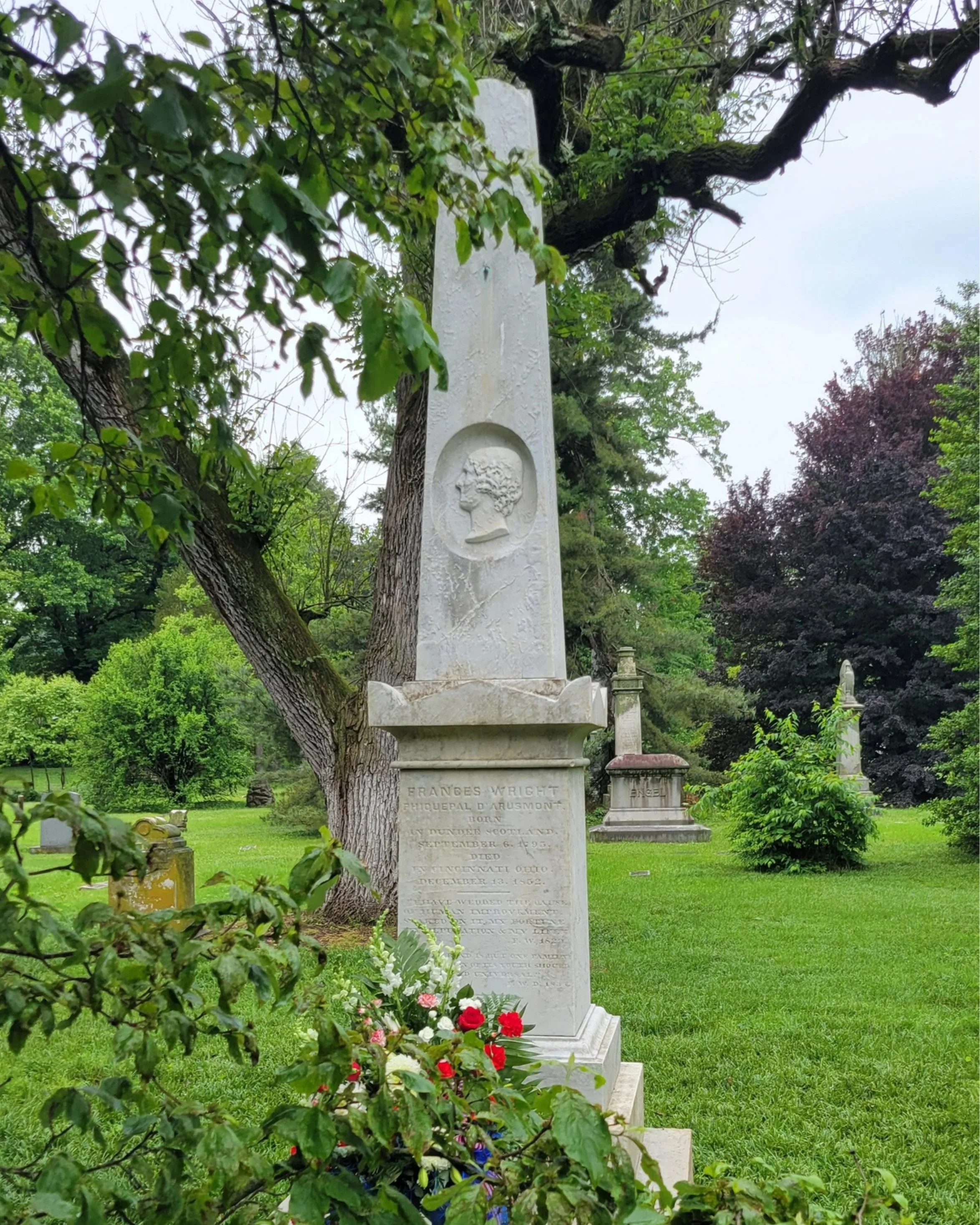
When both the successes and scandals of her lectures died down, Cincinnati became Fanny’s home base again. During her last years in Cincinnati she wrote history, befriended workmen, and strove to regain her fortune and her daughter’s love from a husband turned vindictive. She died there in 1852.
Cincinnati remains Fanny’s final home: Fanny’s estranged daughter Sylva commemorated her notorious mother with a white obelisk nestled among trees in Spring Grove Cemetery.
Trace the rest of Fanny’s extraordinary life story in Founding Radicals: Frances Wright and the Women Who Shaped a Young America, out February 2027. Preorders available now!
Looking for Fanny’s Cincinnati?
The Panorama of Progress at the Cincinnati Public Library is a daguerreotype- an early form of photograph- showing Cincinnati’s booming riverfront in 1848. Although few people are visible, you can almost imagine Fanny striding down the street just around the corner.
The Taft Museum of Art preserves a wealthy Cincinnati family’s residence from the years when Fanny lived nearby— although we’re pretty sure she was too radical to be on their guestlist!
The Harriet Beecher Stowe House documents the abolitionist writer who lived there in the 1840s, the African-American neighborhood of Walnut Hills, and the house’s 1940s history as a Green-Book listed hotel.
Spring Grove Cemetery is not only Fanny’s final resting place, it’s also a beautiful arboretum that exemplifies the garden cemetery movement of the 1800s. Nearly two centuries of Cincinnati’s luminaries are buried there, with monuments ranging from elegant obelisks like Fanny’s to towering gothic chapels, to modern headstones—there’s one shaped like Spongebob Squarepants!